
Introduction
The use of AI-generated content has reached such a high consumption level that it is now a common practice among marketers, SEO experts, and general businesses. However, along with the progression of AI, Google’s capability to detect the difference between inferior, automated content and helpful, original, value-rich content goes up as well.
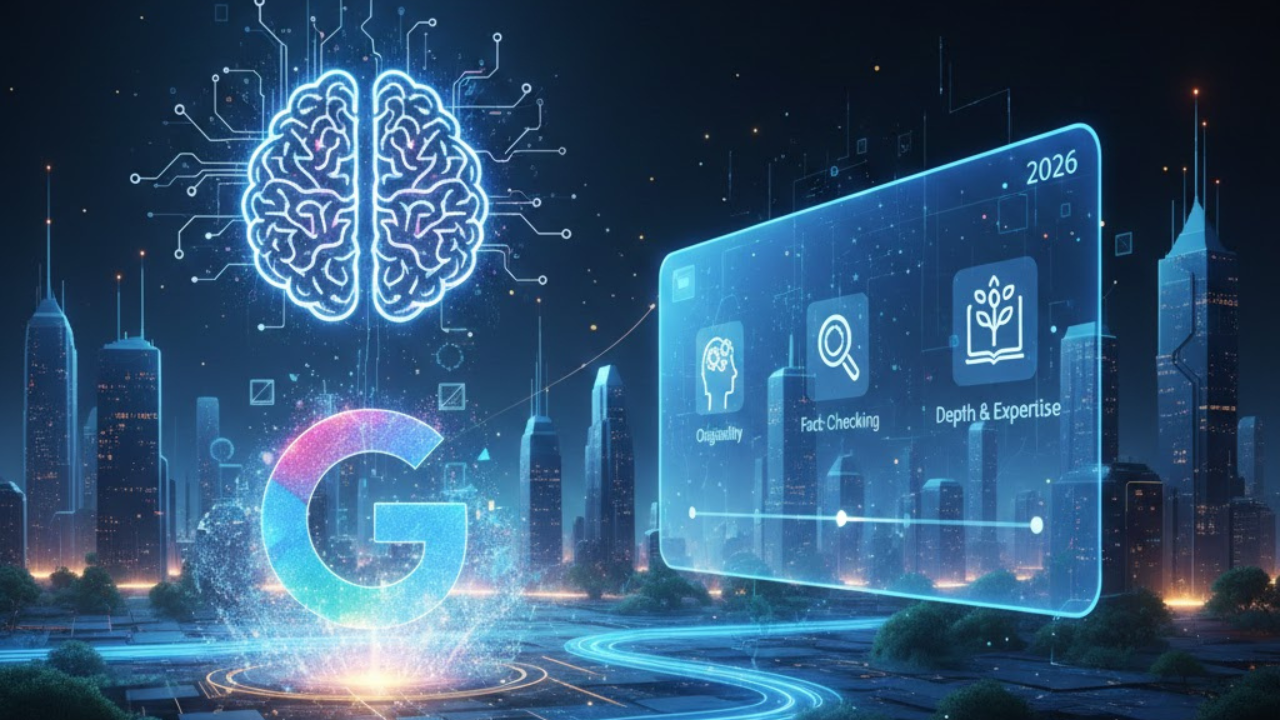
By 2026, Google ranking systems will already have the capability of identifying human insights, originality, factual accuracy, and world-class expertise. The websites, which are relying only on AI for rewriting existing information, will descend, while the others, which are adopting AI duly supported by human experience and editorial reviews, will shine much brighter than ever.
This blog from VirtualAssistantSEO.com clearly delineates what Google will be rewarding in 2026, the future direction of AI search, and how your website can benefit from implementing smart, future-proof content strategies well in advance.
1. Google’s Roadmap for AI Content 2026
Google doesn’t directly punish AI writing but rather its misuse, especially in such cases as:
Unsupervised large-scale content production
Unoriginal or repetitive text
Investment only in ranking pages, not in helping
Doubtful fact accuracy
Authors are not identified or are anonymous
Google’s algorithms will by the year 2026 comprehend to a greater accuracy:
To what extent humans participated
Whether the content is based on personal experiences or not
The amount of original concept and thought
Whether the content truly meets the search intent
In this light, the triad of AI, human beings, and unique data supported by transparent content creation processes will guarantee the SEO success.
2. What Google Will Reward in 2026 (Deep, Expanded, and Clear)
Here are the top-ranking signals Google has outlined, with clearer action points and more details given.
2.1. People-First, Intent-Focused Content
User satisfaction will always remain Google’s primary concern.
In other words, content must correspond to users’ needs at every stage of the search process.
What Google is looking for:
Clear and direct answers given in the first 100-150 words
Well-organized and logical structure
Content that truly helps users
Easy-to-read formatting (e.g., lists, headings, sections)
The big picture for 2026:
With AI-generated content overwhelming the internet, Google has to make sure that users get the most accurate results in no time. Only the pages that really serve the users will be left.
2.2. Strong Originality Signals
This is the most tremendous change.
Often, AI-generated text is a mixture of what is already there. However, one of the criteria of the Google ranking systems in 2026 will be the originality of the content of your page that you are going to submit for evaluation.
Originality types that Google will prefer are:
Case studies
Personal experiences
Data reports or surveys
Frameworks or models unique to your brand
First-hand reviews
Industry opinions or predictions
Step-by-step examples
Conclusion:
Artificial Intelligence can produce content, but human beings should be the ones to provide their perspective.
2.3. Enhanced E-E-A-T
Google is strengthening trust signals even more.
It is necessary to prove:
Who the author of the article is
What makes them qualified
How the text was produced
When it was last updated
Whether it was reliable information or not
Useful E-E-A-T enhancers:
Comprehensive author bios
Social profiles for credibility linked
Citing credible external sources
Including “Reviewed by” editors
Providing update logs
Displaying screenshots, proofs, and real data
The more your expert knowledge is visible, the higher your position will be.
2.4. Transparency in AI Usage
Google will give credit to the websites that responsibly show the use of AI.
No long disclaimers—only honest notes.
For instance:
“This article was created with AI assistance and thoroughly reviewed, edited, and fact-checked by our expert team.”
This creates trust not only with the users but also with the search quality evaluators.
2.5. High Accuracy & Verified Information
One major downside of the AI technology is its hallucinations.
Google in 2026 will give priority to those websites which show precision and cross-verification.
The accuracy signals are:
Data supported by references
Updated statistics
Industry citations
Linking to authority domains (.gov, .edu, trusted .coms)
Adding fact-check badges or notes
The more reliable your information is, the more ranking stability you have.
2.6. Strong User Experience & Technical SEO
Content only is not sufficient.
Google will keep urging sites to enhance general usability.
The main UX features for 2026 would be:
Fast-loading pages
Able to see and read the text easily because of the clear and properly formatted
Quick mobile responsiveness
Good and simple navigation
Clean page layout
No intrusive pop-ups
Graphics and multimedia of high quality
Google is not only interested in providing excellent text but also wants to offer a seamless journey.
2.7. Structured Data for AI-Powered Search Results
The necessity of Schema markup is being felt as AI-based search engines (AI Overviews, search summaries, natural language snippets, etc.) are getting more prevalent.
The following Schema types can be listed to augment ranking:
Article
FAQ
How-To
Author
Breadcrumb
Review
Local Business
This way, Google gets to decipher your content and, in turn, you get to be more visible in the AI-powered search results.
2.8. Multi-Format, Multi-Layered Content
Text-only content will not be sufficient anymore by the year 2026.
High-performing formats:
Infographics
Short videos
Short animations
Charts or graphs
PDFs to be downloaded
Templates and checklists
Tools for interaction
The future is going to be full of rich, helpful, and engaging multi-format content.
3. What Google Will Penalize in 2026
Google will impose penalties on the following:
Unedited mass AI content
Large-scale article production via automated means is a very high-risk area.
Very scant content with no new information
Lengthy posts of 500 to 2000 words will be considered fluff and will not be allowed.
Pages with no affiliate experience
A page that reviews must show real use of the product.
Keyword overuse and unnatural patterns
Google’s artificial intelligence can spot machine-like writing in no time.
Pages created solely for ranking with no assistance to users
Search engines will lower the ranking of pages with little engagement.
Content that is duplicated on several pages
AI-generated rewrites will NOT be regarded as content that is unique.
4. A Future-Proof 2026 Content Creation Framework
Below is an enhanced and comprehensive system your website can adapt.
Step 1: Intent → Keyword → Content Purpose Mapping
Determine the main user’s intention (to inform, to buy, to compare, to fix, to learn).
Associate the core keyword along with the aliases.
Point out the unfulfilled areas of the competitors.
Step 2: AI-Assisted Drafting
Rely on AI for:
Setting up the blog framework
Producing initial manuscripts
Enriching text parts
Providing interrogatives and subtopics
Designing tables and abstracts
Doing schema markup
Though AI manages to create content seven times quicker, it is still not preferable as a final output.
Step 3: Human Enhancement Layer
This is the phase where Google will grant the biggest reward.
Include:
Tangible instances
Geographical backdrop
Market intelligence
Feeling, character, and individual style
Pictures, screen captures, or graphics
Explanatory paragraphs
Authentication of each assertion
This transforms an AI-generated piece into premium content that is ready for ranking.
Step 4: Strengthen E-E-A-T
Include:
Author bio
Editor note
Update history
Citations & references
Links to authoritative sources
Company experience or results
Step 5: UX-Driven Formatting
Increase usage of bullets, short paragraphs, and scannable content
Integrate CTA buttons
Place jump links at top
Provide TL;DR summaries
Utilize visuals or infographics
Establish FAQ sections
Step 6: Structured Data Integration
Insert Schema types pertinent to:
Blog posts
FAQs
Reviews
Authors
This enhances the accessibility of your content to both the search algorithms and the AI search tools.
Step 7: Publish → Monitor → Optimize
Once content is live:
Monitor rankings on a weekly basis
Observe CTR and user engagement
Assess the extent of scrolling
Refresh the content after 30, 60, or 90 days
Conduct technical health checks
Introduce new insights frequently
SEO in 2026 is no longer a matter of “publish and forget”—it now requires a continuous cycle of publishing and improving.
5. Content types that Google rewards the most
data-backed industry guides
content that is reliable and based on research.
case studies with real outcomes
showing experience and creativity.
local SEO pages with personalized content
specificity is the key to winning.
opinion-based thought leadership
human insights are better than AI.
problem-solving tutorials
step-by-step instructions for clearly presenting the solution.
real use comparisons
testing data lets one trust more.
hybrid AI + human content
being efficient, accurate, and keeping balance.
6. A 2026–Ready Blog Format
The following is a suggested structure for blogs :
Title centered around the keyword
Powerful introduction of 2–3 sentences
Bullet-style TL;DR section
Intent-driven H2/H3 sections
Case study or a real-life example
An actionable checklist
Visual aids (table, graphic, comparison chart)
FAQs with Schema markup
Author bio + editorial process note
Update log for trust signals
This blogging approach is likely to gain significant visibility in classic as well as AI-enhanced search results.
Conclusion
The SEO battle of the future will be won by those who implement AI’s power alongside human skills in the right proportions.
In 2026 Google will favor content that is:
Really useful
Original and insightful
Factually accurate
Expert-driven
User-friendly
Clearly indicating AI usage
Strengthened by top-notch technical SEO
VirtualAssistantSEO , can reign the SERPs by creating content that extends the reach of AI through human intelligence, creativity, and credibility.